Custom web application development
Tailor-made portals, dashboards and internal tools that automate your workflows — from quotation systems to project tracking and approvals.
Enquire about this service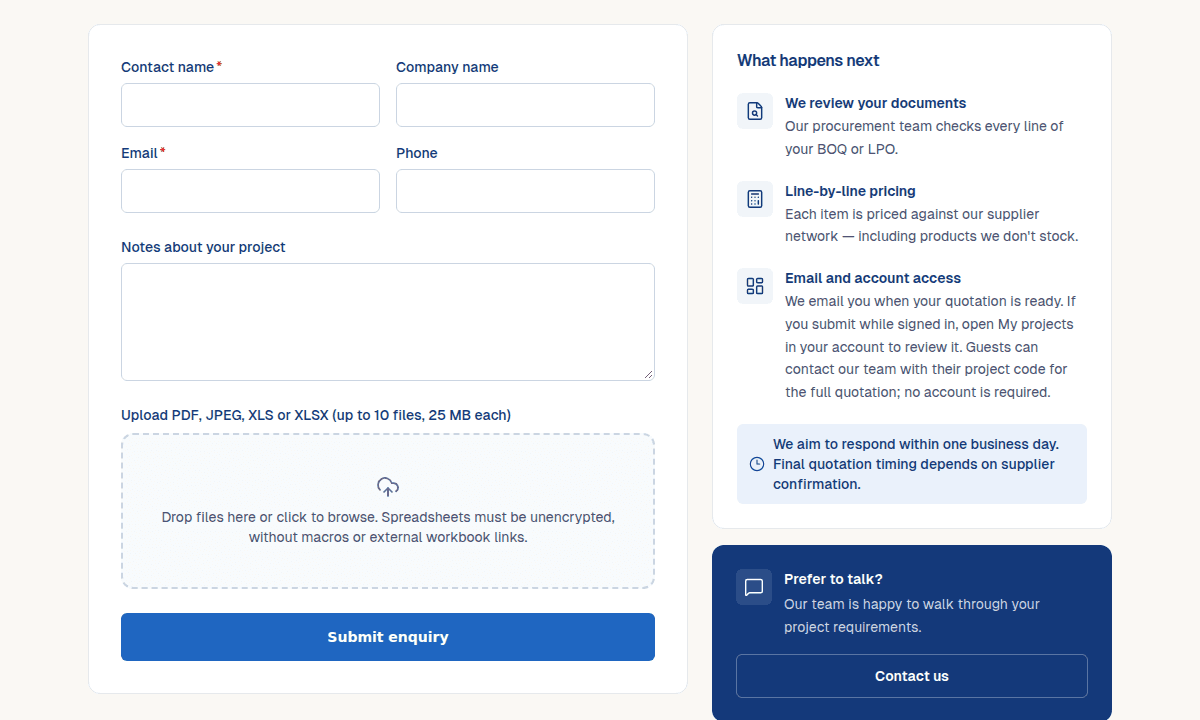
Typical deliverables
Deliverables at a glance
- Requirements and workflow specification
- Role and permission model
- Responsive application interface
- Agreed integrations and data validation
- Acceptance test checklist
- Deployment and administration documentation
How the work is delivered
Workflow discovery
We map current steps, users, approvals, data sources, exceptions and reporting needs. Unclear rules are resolved before they become software behaviour.
Prototype and technical plan
Key screens and data relationships are reviewed with stakeholders. The plan identifies integrations, permissions, security assumptions and acceptance criteria.
Incremental delivery
The application is delivered in reviewable stages so real users can validate critical workflows before the complete release.
Acceptance and operation
We test roles, validation, error states, responsive layouts and agreed integrations, then document deployment, backup and administration responsibilities.
Service details
Off-the-shelf software rarely fits the way your business actually works. We build custom web applications around your processes: customer portals, quotation and approval workflows, inventory dashboards, field-service tools and more.
How we work
We start with your workflow, not the technology — mapping the steps your team takes today and where time is lost. Then we design and build in short iterations, so you see working software early and steer the direction. User roles, access permissions, audit records and any English/Arabic interface requirements are defined in the approved scope. Integrations and data migration are quoted after reviewing available interfaces and source data.
Technology
We build on proven, maintainable stacks — TypeScript, Next.js, Node.js and PostgreSQL — and hand over clean code with documentation, so you are never locked in.
Who this service is for
Custom application work is intended for organisations whose process no longer fits spreadsheets, email threads or a standard website plugin. Typical requirements include customer or supplier portals, approval workflows, quotation systems, dashboards, internal administration and integrations between existing systems.
Expected outcomes
- A documented workflow with clear user roles and decision points.
- A maintainable web application focused on the agreed operational tasks.
- Controlled access, audit-friendly records and practical handover documentation.
What we need from you
- A named decision-maker and the people who will review operational or technical details.
- The business goal, intended users, target market and the problem the service should solve.
- Accurate product, service, brand and policy information, with approval to use supplied assets.
- Appropriate access to the accounts, platforms, analytics or infrastructure included in the scope.
- Known deadlines, dependencies, compliance requirements and any internal approval process.
- Consolidated feedback at agreed review points so changes can be assessed and scheduled clearly.
Planning and timeline
Timing depends on the number of roles, workflows and integrations. A small internal tool can be phased sooner than a customer-facing platform with payments, external APIs and data migration. We provide milestone estimates after discovery rather than promising an unsupported fixed duration.
Scope, ownership and controls
- The proposal records included work, exclusions, milestones, responsibilities and acceptance criteria.
- Third-party subscriptions, advertising spend, marketplace charges and infrastructure fees are identified separately.
- Primary accounts, business data, legal credentials and billing ownership remain under the client's control.
- New requirements are reviewed as scope changes before they affect timing, cost or completed work.
- Platform approvals, rankings, sales and supplier-controlled outcomes are never presented as guaranteed.
- Confidential information and personal data should be shared only through the agreed access and storage method.
Relevant delivery evidence
Rapidz contains working examples of custom commerce workflows: product and brand administration, customer accounts, RFQ basket handling, BOQ submissions, quotation management, multilingual catalogue data and operational dashboards. These are evidence of implementation capability, not a claim that every project uses the same architecture.
Frequently asked questions
Can the application connect to our existing systems?
Where a supported API or reliable data interface exists, integrations can be scoped. Access, rate limits, ownership and fallback behaviour are confirmed before commitment.
Who owns the source code and data?
Ownership, repositories, infrastructure and third-party licenses are stated in the commercial proposal so there is no ambiguity at handover.
Can the application be expanded later?
Yes, when the initial scope uses clear module and data boundaries. Future ideas are recorded separately so they do not destabilise the first release.